
Picture: Tom Alexander and I in my greenhouse 2018.
I am pleased to announce that Tom gave me permission to scan my entire collection of Sinsemilla Tips in its entirety and post them online for the community to be able to reflect on some 40 years later. I just got his permission last week when he called and I will start working on the project at the end of July.
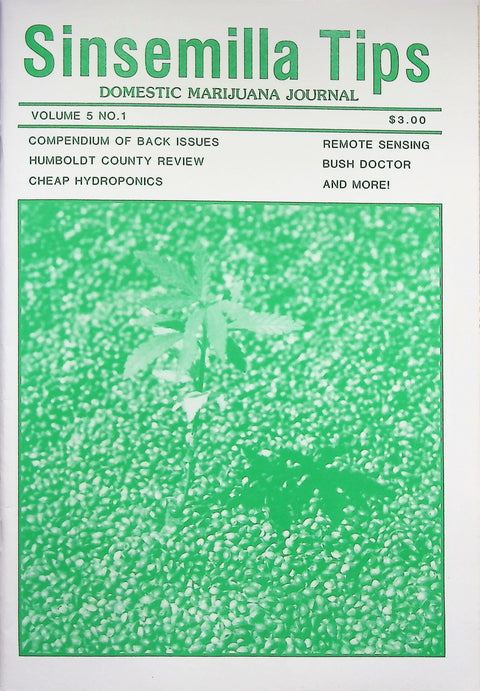
My first introduction to "Tips" was in 1984 when my friends brought me to downtown Providence because they wanted to pick up something called Rush. Because I was under age, they wouldn't let me into the back of the store where they had the bongs and stuff, but they did allow me to look at the magazines which were mostly Playboy and the like, but what caught my eye was Sinsemilla Tips, a magazine devoted to the cultivation of Cannabis. I used all the money I had on me to buy three of the copies they had on the shelf and my friends all thought I was crazy, but here we are and now and the publisher Tom is one of my good friends.
This will be the beginning of many postings of Sinsemilla Tips for your viewing pleasure.
Tribute to David Watson (Sam Selgnij)
David Watson, writing as Sam Selgnij in the pages of Sinsemilla Tips in 1984, was sharing the kind of grounded, experienced knowledge that came from years of serious cultivation during the height of prohibition. Sinsemilla Tips, published quarterly by New Moon Publishing, served as a practical journal for domestic growers. The articles from Volume 5, Number 1 that you have here stand out because they combine hands-on advice with a clear understanding of the larger picture — genetics, community, and the need to protect what makes cannabis distinct.
In “How to Plan a Neighborhood Harvest Festival,” David provides a straightforward framework for small, invitation-only events where growers could safely compare their results. He details the importance of privacy, the value of good food and music to set the tone, and a structured judging approach that scores buds across appearance, fragrance, taste, general quality, and the character of the high itself. The emphasis is on meaningful evaluation rather than casual competition or commercial spectacle. It reflects the careful, community-oriented side of the scene at that time.
“Soil Building the Northern California Way” is one of the most thorough pieces in the issue. Selgnij walks through a full seasonal process that begins in January. He starts with a base of redwood sawdust (noting finer ground material as preferable), incorporates rice hulls or cocoa bean hulls, Canadian peat moss, and a range of organic additions including composted clippings, kitchen scraps, coffee grounds, and fresh or prepared nitrogen sources such as manures, fishmeal, or bat guano. He explains the multi-month composting sequence, turning schedules, temperature and moisture management, pH adjustments with materials like oyster shells or dolomite lime, and the importance of avoiding common problems like excessive ammonia or nutrient lockup. Vegetarian alternatives are included for those who prefer them. The guidance extends to final planting mixes, flowering amendments, watering strategies, harvest timing, slow drying in darkness, and long-term storage. It is the writing of someone who has built and maintained productive soil systems over many seasons, not abstract theory.
The article “Cannabis: Her Story” offers a concise history of how varieties moved through the American market. Selgnij traces the early prominence of Mexican sativas such as Acapulco Gold, the commercial rise of Colombian material, the appeal of Thai sticks, and the subsequent shift toward faster-maturing Indica genetics from Afghanistan and neighboring regions as growers adapted to shorter seasons and market demands. He discusses the results of hybridization — increased potency and reliability in some respects, but also the gradual displacement of pure landraces and the loss of distinctive regional characteristics. The piece closes with a direct observation: those who approach cultivation as a dedicated practice have an obligation to maintain genetic diversity rather than allowing commercial forces to narrow it. That perspective has proven especially important in the decades since.
These articles are connected by a consistent thread in Watson’s work: respect for practical growing knowledge, attention to quality in all its aspects, and a commitment to preserving the plant’s genetic heritage.
Watson’s contributions extended far beyond these early writings. He was centrally involved in the Sacred Seeds efforts in the 1970s, where collectors gathered landrace material from Afghanistan, Thailand, Colombia, Mexico, and other regions. That work fed directly into the development and stabilization of influential hybrids, including Skunk #1, whose consistency, vigor, and distinctive profile became foundational to much of modern cannabis breeding. In the mid-1980s he carried extensive seed collections to Amsterdam, helping establish the basis for the European seed industry. He went on to found Hortapharm B.V. and worked closely with Robert Clarke and others, creating one of the most comprehensive cannabis genetic libraries of its time and conducting systematic breeding under Dutch research permits. That work supported the move toward standardized, high-quality material for medical applications.
Watson was also the founder of the International Hemp Association (IHA). He played a leading role in establishing the organization and its peer-reviewed journal, advancing research, education, and germplasm preservation on the industrial hemp side while maintaining the same emphasis on science, diversity, and responsible development that marked his cannabis work.
From the underground gardens of Northern California to international breeding programs and institutional research, David Watson approached the plant with seriousness and foresight. He understood the value of landraces, the importance of careful selection, and the need to bridge traditional cultivation knowledge with legitimate scientific and medical applications. The articles in Sinsemilla Tips give a clear view of that foundation in its early form — detailed, experienced, and forward-looking.
Re-reading them now, it is evident how much of that early perspective continues to matter. In an era of rapid commercialization, the focus on genetic preservation, soil health, and quality evaluation serves as a useful reference point. These pieces, along with Watson’s larger body of work, represent a commitment to doing things properly and protecting what is essential about the plant. That legacy remains present in seed collections, breeding efforts, and cultivation practices that continue to value diversity and experience over trends.


