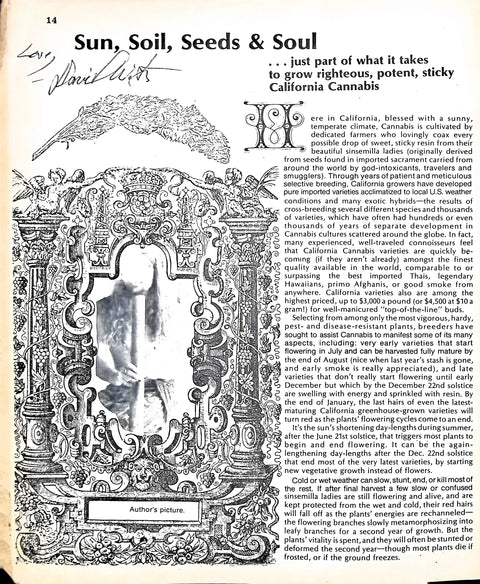

David Watson was a Cannabis genius and was already establishing his voice decades ago. In the 1979 issue of Blotter (No. 2/4), he contributed the substantial article “Sun, Soil, Seeds & Soul” under the name "Selgnij", which was his trippin' nickname, "Jingles", spelled backwards.
This longer piece offers a comprehensive look at what it took to grow high-quality cannabis in California at the end of the 1970s. It covers climate advantages, the origins of sinsemilla techniques through imported genetics, patient selective breeding, and the development of vigorous local hybrids adapted to local conditions.
Watson describes the rapid improvement in California varieties through years of careful work — crossing imported landraces and selecting for traits suited to the region’s sunny, temperate climate. He notes the resulting plants often matched or surpassed famous imported materials in quality, with well-manicured tops commanding significant prices at the time. The emphasis is on choosing hardy, pest- and disease-resistant stock, timing flowering cycles (including techniques for early and late varieties), and using greenhouses to extend seasons and protect against weather.
The breeding section is particularly detailed. He explains basic genetics, inbreeding and backcrossing strategies, the importance of maintaining vigor through selective crosses rather than extreme inbreeding, and practical methods for producing stable seed lines. Diagrams and explanations cover single crosses, double crosses, and how to evaluate and stabilize desirable traits across generations while avoiding loss of hybrid vigor. It is methodical writing aimed at growers who wanted to improve their own stock rather than rely on whatever was available.
The soil discussion continues the practical tone. Watson provides specific recipes for fertile, living mixes using compost, worm castings, horse manure, redwood sawdust, sandy loam, rock phosphate, dolomite, kelp, fish meal, and trace elements. He stresses balanced nutrition, aeration, pH management (slightly alkaline around 7–8), and avoiding over-fertilization or chemical approaches that can burn roots or create imbalances. Root health, container vs. in-ground growing, and protection from pests are all addressed with the same attention to detail seen in his later work.
The “Soul” portion ties the technical advice to the grower’s relationship with the plants. He speaks to the importance of care, attention, and positive conditions — including the benefits of a well-managed greenhouse for controlling temperature, humidity, and light to produce better flavor and potency while minimizing mold and stress. It is not sentimental language but a recognition that the cultivator’s approach affects the final outcome.
This 1979 article shows Watson’s thinking already fully formed: a combination of practical cultivation knowledge, breeding principles grounded in observation and selection, and an understanding that quality comes from the full system — sun, soil, seeds, and the care that connects them. It predates the Sinsemilla Tips pieces by several years and demonstrates the consistency in his perspective across the late 1970s and 1980s. The same focus on genetic stewardship, soil health, and producing genuine quality appears here and carries through his later breeding programs, Hortapharm, and the founding of the International Hemp Association.
Together with the 1984 articles, these writings form a clear record of David Watson’s contributions as both a grower sharing usable knowledge and a breeder working to preserve and improve cannabis genetics under difficult conditions. They remain useful references for anyone interested in the history and fundamentals of serious cultivation.


Sun, Soil, Seeds & Soul.
David Watson a.k.a. Skunkman Sam & a.k.a. Jingles (backwards =) Selginj, wrote this in 1978 and it was published in 1979.
(Note bt Todd: when reading this, please keep in mind that this man was having all of these realizations and trying to educate people about Cannabis 48 years ago. Many of the people in the industry today don't know a small percentage of what he was trying to explain in these pages. Enjoy the read and burn one for David as you do!)
Here in California, blessed with a sunny, temperate climate, Cannabis is cultivated by dedicated farmers who lovingly coax every possible drop of sweet, sticky resin from their beautiful sinsemilla ladies (originally derived from seeds found in imported sacrament carried from around the world by god-intoxicants, travelers and smugglers). Through years of patient and meticulous selective breeding, California growers have developed pure imported varieties acclimatized to local U.S. weather conditions and many exotic hybrids – the results of cross-breeding several different species and thousands of varieties, which have often had hundreds or even thousands of years of separate development in Cannabis cultures scattered around the globe. In fact, many experienced, well-traveled connoisseurs feel that California Cannabis varieties are quickly becoming (if they aren’t already) amongst the finest quality available in the world, comparable to or surpassing the best imported thais, legendary Hawaiians, primo Afghanis, or good smoke from anywhere. California varieties also are among the highest priced, up to $3,000 a pound (or $4,500 at #10 a gram!) for well-manicured “top of the line” buds.
Selecting from among only the most vigorous, hardy, pest and disease resistant plants, breeders have sought to assist Cannabis to manifest some of its many aspects, including: very early varieties that start flowering in July and can be harvested fully mature by the end of August (nice when last year’s stash is gone, and early smoke is really appreciated), and late varieties that don’t really start flowering until early December but which by the December 22nd solstice are swelling with energy and sprinkled with resin. By the end of January, the last hairs of even the latest maturing California greenhouse grown varieties will turn red as the plants flowering cycles come to an end.
It’s the sun’s shortening day lengths during summer, after the June 21st solstice, that triggers most plants to begin and end flowering. It can be the again lengthening day lengths after the Dec. 22nd solstice that end most of the very last varieties, by starting new vegetative growth instead of flowers.
Cold or wet weather can slow, stunt, end, or kill most of the rest. If after final harvest a few slow or confused sinsemilla ladies are still flowering and alive, and are kept protected from the wet and cold, their red hairs will fall off as the plants’ energies are re channeled- the flowering branches slowly metamorphosing into leafy branches for a second year of growth. But the plants’ vitality is spent, and they will often be stunted or deformed the second year – though most plants die if frosted, or if the ground freezes.
Because flowering in almost all types is induced by shortening day lengths (photoperiod), by planting seeds a little earlier than usual here in the San Francisco Bay area, say in March – the plants will be bigger at harvest. But they will still flower only a few weeks or so earlier than seeds of the same variety and from the same batch planted in June. And because early planted seeds also often get usually the same weight of stash by planting in May or June (the best time). In other words, plant ten seeds early and you’ll get approximately three or four big females. On the other hand, ten seeds planted in May might yield five or six medium sized females. About the same weight both ways but with the benefit in the latter instance of two months less work and chance to be found! This is important… unless you’ve got lots of good seeds, plenty of time and an acre of land somewhere it’s legal.
Crowding your plants gives similar results. You’ll get lots more, but smaller plants and more males ending up with less stash than if the plants were properly spaced in the first place. There should be a minimum of three feet between plants. Six feet is better for outdoor amazons.
Many people pinch or prune plants they consider too tall. This is a waste of your plant’s vital energies, and it usually is better to gently break, bend or severely tie back the branches thereby increasing your yield in a smaller space.
Seeds planted here late in the season say, August, will be smaller plants, but flower only a week or two after seeds of the same variety and from the same batch planted earlier. By using artificial lights and reducing photoperiod, or by totally covering plants part of the day to reduce the sun’s photoperiod, you can artificially induce early flowering. But the only real way to have true early or late plants is by the variety of seed used. If genuine early plants are wanted, choose your healthiest, stoniest, earliest flowering male and female plants for next year’s seed crop. (Mexican strains are often early.)
If natural light plants are started extra early, say in March, they’ll be large enough to start depriving them of light as early as July 1st. By covering or moving them to total darkness, this will yield buds several months earlier than its natural cycle.
Early plants, besides giving early smoke, are also nice because after they’ve flowered and been harvested, they’ll leave more room and light for the late varieties. Smaller and early type container plants placed between large in ground plants are also good for making the most of limited space. However, containers (even 15 gallon size) will cramp roots and produce plants stunted like bonsai (although still sweet, sticky and potent).
For a late flowering plant what is needed is a vigorous, hardy, resistant variety that flowers late yet isn’t adversely affected by cold or short days. Seeds from Afghanistan, Kashmir, Pakistan, Russia, China and Nepal are often good to try for late plants because besides more likely being drug types they’re already from a cooler and shorter fall photoperiod of a northern climatic area. Nearly 100 years ago the British Hemp Commission found that some of the most active and potent hash was produced in the Yarkand are (just above where Afghanistan, Pakistan, Kashmir, Russia and China all meet at altitudes of 5-10,000 feet). At a 38degree latitude, which is north of San Francisco Bay area! Although it’s drier in the Yarkand area than San Francisco during flowering season of Aug-Dec., with a greenhouse the San Francisco area can match the best stash grown anywhere. (Finding seeds from the Yarkand area is another thing.)
Most seeds available in the U.S. are Cannabis sativa from Mexico or Colombia, aside from Thai or a few seeds found in hash. Cannabis sativa for hemp fiber has been heavily cultivated in Chile since 1545, in the Americas for several hundred years, and elsewhere worldwide for thousands of years. For hemp, a straight, tall, fast growing, early and even maturing plant with few branches was bred because all that was wanted was long, straight fiber.
Because for fiber only immature plants with little or no resin are used, breeding Cannabis sativa in the Americas for resin wasn’t begun seriously until the last century, except for maybe a few isolated primitive situations involving imported Negro and Indian slaves. In some breeds of Cannabis Indica, by contrast, God’s grace and careful selection for thousands of years by generations of patient, stoned farmers have raised resin quantities and qualities astronomically. Of course by now, Cannabis Indica has been introduced by smugglers, etc. to most Cannabis growing areas of the world.
“Because marijuana is a prohibited substance, it has an inflated market value. That inflated market value is such that it is very attractive to anyone that doesn’t have a knee jerk response to what is lawful or unlawful. In short, I don’t understand why everybody isn’t growing at least five plants, because it is just so lucrative. You are looking at a thousand dollars a plant. It is something that is very easy to do.” – Asst. S.C. County D.A. Ralph Boroff, calling for the California legislature to legalize marijuana
Of the hundreds of varieties from the 1979 domestic California harvest, the three best seen were later flowering and maturing toward the end of December and even January. By “best” I mean not the biggest – though nice, big flower bracts covered with resin, with a low leaf ratio is pretty nice – but the resins, when the plant is mature at harvest, that are the sweetest smelling and tasting, gooiest and strongest. Even more important, these resins also have a sweet, clear, psychedelic high – not a muddy, cloudy, downer stone, like bunk seeded Colombian. Even though Colombian can be strong, most is not a pure high. It’s just a stone.
One of the troubles with Cannabis indica is that often the plants were cultivated for hash alone and the plant can be quite leafy, though still very gooey and potent, since what many overseas hash farmers really wanted was the resin heads from their plants – because they didn’t smoke the flowers, just the hash resin. So the plants were bred for resin, not flowers (such as good smoking ganja like Thai, which is what most California growers want).
Seed
If you plan on breeding Cannabis, a simple introduction to genetics and breeding techniques used by professionals will help smooth the way. For 10,000 years and until fairly recently most Cannabis improvement has been by selection and acclimatization – that is, by a choosing of the best plant (or maybe a special new mutant or sport) each year. At the least, this has been done by selection of the plant closest to the traits desired and a rejection of all the others. But even the best imported, pure strain, hybrid or domestically acclimatized strains will decline quickly in future generations unless only the very best of each variety is chosen each year.
Enough years of selection for similar traits will usually yield a true variety – that is, a pure strain that when the female is pollinated by males of the same variety will produce only offspring resembling the parents. If you want to grow pure strain seeds, then you must cross the best few females of each different type with the best couple of males of the same type.
(To do this properly a thousand females and 1 thousand males need to be used for a landrace maintenance, or gene loss will occur.
Statistical genetic considerations for maintaining germ plasm collections J. Crossa , C. M. Hernandez , P. Bretting , S. A. Eberhart , S. Taba Theor Appl Genet (1993) 86:673-678 DOI: 10.1007/BF00222655)
Several of both are used to help insure genetic diversity and to avoid loss of vigor that inbreeding extremes can cause, such as the strain running out of juice. Another way is to backcross with the original imported seed.
This is presuming one has pure strain seeds to start with, and the odds are against this for several reasons. 1) With unseeded pot, the higher the quality the more likely the farmer pulled his males to produce sinsemilla. So where did the pollen that produced any stray seed come from? Off the farm? Hermaphrodite development? Probably not the same variety, anyway. 2) If pot is heavily seeded, then the farmer either didn’t care or wanted the seed weight for bucks or just can’t grow high quality sinsemilla. 3) Seeds from U.S. domestic varieties are unfortunately almost all hybrids, because of time and space difficulties in maintaining pure strains. 4) All the seeds from one bud don’t necessarily have just one father.
Now by inbreeding any unknown or hybrid seed, you can try to breed backwards with the hope of manifesting all the parents of any hybrid. These plants can be inbred until one or several pure lines emerge, depending on the variety. Remember when pure variety seeds are grown, Planted at the same time in the same soil, sun, water, etc., they should all be pretty similar to one another. On the other hand, two plants of more than one type which are allowed to do their own thing will produce a batch of hybrid seeds, with only some, but not all, resembling their parents.
Pot has 20 chromosomes, 10 from the female flower and 10 from the male pollen. These recombine upon fertilization to form a new 20 chromosome seed.
Although all the genetic material from both parents is present in any f1 hybrid generation, some characteristics are recessive and temporarily subordinated but not eliminated, unless/until these f1 hybrids are bred among themselves. Then the f2 generation produced will be diverse and not all individuals will include all the genetic material of both grandparents. Some of the f2’s (25%) will be like the grand dad, 25% will be like the grand mom, and most (50%) like the f1 hybrid parent generation (although looking like the dominant grandparent).
Now don’t start thinking all hybrids are bad. In fact, they’re often more vigorous. But their characteristics are just not predictable at first and you can lose good characteristics or pick up bad ones much more easily than you can find good ones. However, if you have the time and energy, then hybrids will definitely be the future. Remember, a superior hybrid isn’t developed in one generation. It takes several years of careful research and controlled breeding. Only the desirable traits must be maintained as dominant, as undesirable ones are discouraged.
As long as you keep sufficient duplicate seeds, for backcross and comparison purposes, etc., of your parent stock and keep records of all cross pollination’s, you can go back and rebreed to try to produce any hybrid you think might be exceptional enough to work further on. This can be done by inbreeding the f1 hybrid generation for several generations and selecting for good traits. This will set these traits, enabling the stain to stabilize and become a homogeneous new true variety that breeds true. (Luther Burbank says, “Heredity is indelibly fixed by repetition.”) Or, one can go back on a good hybrid and inbreed both of the original parents in hopes of concentrating the good traits, and then rebreed the two separate variety inbred parents together and maybe make the resulting hybrid better or more consistent than before.
Or one can backcross hybrids. Say you have a pure variety Nepali plant that’s early, gooey, colorful, sweet, tasty, high stone, etc, but is a very small plant. So you cross it with a tall Mexican variety that’s not so good except in size and vigor. The first cross between the two varieties might yield some taller plants that are also early, gooey, sweet, etc, but not quite as good as the original pure Nepali. So you backcross the f1 hybrid Nepali/Mexican with a pure Nepali, making the resulting f2 progeny 3/4 Nepali and 1/4 Mexican. Now picking the tallest and otherwise best plant, again cross this f2 hybrid with a pure Nepali, yielding, hopefully , a tall, gooey, colorful, sweet, stony plant that’s 7/8 Nepali and 1/8 Mexican.
To get some idea of some complications, here’s an example, assuming you have pure, tall, red plant and a pure, dwarf, white plant. In this example, tall and red are dominant and dwarf and white are recessive. What you want to create is a tall, white or dwarf, red plant.
To do it, first you cross the tall red with the white dwarf, and you get an f1 hybrid generation that appears to be all tall and red, because the dwarf and white are recessive and they are temporarily subordinated.
However, when the f1 hybrids are crossed with themselves, they’ll yield many more genetic positivities, which include three dwarf red and three tall white, marked by an asterisk as illustrated:
(See scan above)
While it looks like we have three dwarf reds and three tall whites, really only one of each is pure genetically. The rest are still hybrids.
So you need to self breed these pure appearing plants and see which ones really breed only true. But remember that the males need to be tested too, so it’s twice the hassle. If two traits are involved, a minimum of 16 plants are needed to see all the possibilities. For three traits, 64; for four traits, 256, etc., and that’s not considering complications. For example, instead of each trait being controlled by one gene, several genes can control one trait. Or several traits can be bound together, or neither trait is dominant, as follows:
Diagram (See above)
Don’t use hermaphrodite male flowers, as some growers advise, to pollinate the female plants you want to seed for next year. Although the seeds produced will be almost all female, up to half of the ladies will have those aggravating hermaphroditic tendencies.
So if you are growing more than a few plants and want sinsemilla, don’t use hermaphrodite produced seeds. It’s almost impossible to find all the male flowers scattered over the ladies and one male flower will try to do in a hundred ladies. Cohchicine is also generally a waste of time. It mutates plants, but not in any predictable pattern. It’s a lot easier to find a few primo seeds from a friend (or hope they go on the market soon).
To help keep track of breeding procedures, many farmers keep a journal for records including seed sources and all pollenations and other pertinent information, seeds in separately numbered bottles and individual male and female plant and pollination labels. Hand collect separate male pollens on a mirror or in paper bag, and put in small labeled bottles (will keep at least a week if maintained dry and cool). (longer if frozen after drying)
Using a cotton swab or small brush, you are ready for pollinating. Select plant branch tips and mark with color coded yarn, using a different color for each different variety male. But remember to keep pollens separate, and be careful around ladies. Pollen is very small and light. Wind, hands, breath and tools carry potent pollen all too easily.
It’s possible with ten different varieties, using one female and one male of each, to produce ten pure varieties and 90 different hybrids by pollinating ten different branches on each of the ten ladies, one branch with each of the ten males, keeping them carefully marked and separated. The males can, if necessary, be grown in cans or be pruned back drastically to conserve room for the ladies. As long as a male isn’t allowed to really flower fully due to pruning, it will live almost as long as a female. But if grown around ladies, the males must be checked twice daily to make absolutely sure that no male flowers have a chance to open. Just remove any male flowers that look ready and that you don’t need yet.
Breeding can be fun, but it isn’t quite as easy as it may sound. New or old plant strains can be good, yet carry recessive genes just waiting to manifest bad characteristics again. Luther Burbank said; “Less than one in a thousand new plants are worth saving!”
Soil
Besides a good seed, any primo plant needs a fertile, living, organic soil to be really healthy. For a cubic yard of soil (enough to fill approximately 10-20 3ft deep by 3ft wide holes for plants) use 40% compost (or worm castings or horse shit), 30% aged or composted redwood sawdust and 30% sandy loam. Add 5 lb. greensand, 5 lb. rock phosphate, 5 lb. dolomite, 3 lb. hoof and horn meal (or 3 lb. fish meal), and 2 lb. kelp with no salt. Also; enough trace elements, with iron sulfur, for a yard of soil. Agricultural frit is a good source but don’t overdo it!
Mix well, and allow to “set” at least a few weeks. Then test for PH. With Dolomite, adjust the pH to between 7 and 8 – slightly alkaline). You might want to use sterilized potting soil for starting your seeds, if you’re short of good seeds and fear damping off. And a cat or mouse trap, if you have mice.
Sprouts and young plants, kept off the ground, say on a table with a 1/4″ wire mesh screen cage on top and around them will also keep out mice, yet admit light and air. crickets, slugs and other insects will eat young sprouts. It’s pretty discouraging to wake up one morning to find out that the one ten year old hash seed you’ve saved and carefully hand germinated was some bug’s dinner! Destroy any questionable bugs or use fine window screening, instead of 1/4″ mesh, to protect your ladies.
With enough room (5 feet between plants if possible) and a loose, aerated, organic soil, thousands of tiny hairlike roots will make available the nutrients that can help grow giant, potent, gooey ladies. A good sized healthy plant can easily have a 50 gallon volume of roots, mostly very fine and spread out, not so much deep down. Anyone who thinks Cannabis roots are all small just hasn’t seen a really healthy plant. If seeds are started in little 4″ peat pots, transplant before one month to avoid stunting. Larger container plants should be planted in the ground before flowering.
Too many people also seem to think that if a little fertilizer will work well, then twice as much should work twice as well! It doesn’t work that way. Excessive fertilization can burn, poison or overload the plant with one nutrient (preventing the plant from having a balanced intake of the other necessary nutrients). Strong, harsh, chemical fertilizers can stunt or burn the delicate tiny roots, and that’s where all the nutrients needed by the plant are absorbed. Another thing that can be deadly to roots are gophers. You might want to try placing underground 2 foot by 2 foot deep 1/2″ metal wire mesh open top planting cages that let the roots breathe and even grow through, yet protect. You’ll want to cut off all nitrogen before flowering begins, through organic fish emulsion is great to add with watering until then. A little wood ashes, or kelp (potassium) and burned bone meal (phosphorus) seem to help flowering and guard against cold and mold. Liquid kelp can be added almost to the end of flowering.
Contrary to belief of most, Cannabis plants need lots of watering, don’t get the plant wet if possible, up to and during flowering. Otherwise the flowers can easily be stunted. Just don’t let the roots stand in water for long, which can cause the plant or roots to mold, especially in cold weather. Only the atmosphere should be dry during flowering, not the soil. It’s usually okay and even better to stop all watering (plants in the ground) several weeks before harvest, to help keep the atmosphere drier and prevent plant rot, especially in a greenhouse.
Soul
Besides seed, soil, water and lots of sunshine, your plants need all the love and good vibes you can spare. After all, your plants can only return to you what energy you give them. Little things help, like referring to your young unsexed plants only in the female gender, and even giving your sprouts ladies’ names!
A lot of growers swear that the individual grower’s vibes will make a lot of difference in the potency and the type of high.
For the very best quality in most areas, a dry greenhouse is needed to help lengthen the flowering season. Without a greenhouse, cold or wet weather may very well shorten the normal extended flowering period for sinsemilla. Of course, by seeding the flowering females the flowering cycle can be brought to an abrupt end. This produces not sinsemilla, but often very good pot.
In a greenhouse, heated or not, at least it’s drier and warmer than outdoors and will help protect the taste and high from a cold rain or frost which can blacken the flowers and harshen the taste. If the greenhouse temperature can be kept at around 80degree’s F. during the day and not below 50 degree’s f. at night, the flowers will be bigger and gooier than an unheated greenhouse because cold usually slows the flowers’ growth. If not kept dry though, watch out for mold. A greenhouse also enables earlier and later plantings. But unless you’ve got a 20 foot greenhouse, don’t plant too early (before June) or you’ll get a giant. Some greenhouse disadvantages are: too hot, too wet, no air circulation and bugs. Get bugs fast before they spread. Use an exhaust fan to avoid heat and a wet atmosphere.
Harvest the plants when all the hairs have turned red except a few on the top buds, unless grown outside. Then harvest before it gets too wet and cold. Now, some people enjoy the high from earlier pickings, claiming it’s sweeter and higher. Really, it’s personal preference. If harvesting for seeds, wait until they are dark and rattle. Care must be taken that seeds are completely dry, dry the seeds below 80 degree’s to insure vitality, before you package them airtight for storage. A little silica gel placed in a small airtight bottle, with a smaller bottle inside containing the seeds, will absorb any extra moisture and protect even frozen seeds. Otherwise, they’ll mold. (Avoid direct contact between seeds and silica gel to prevent seeds drying so much they crack.)
If possible, cut plants whole, without roots, and dry them slowly by hanging them upside down in a dark warm room, at a constant temperature between 50-80 degree’s. Try to keep the temperature within 10 degree’s whatever temperature you use, for a smooth, sweet taste. It should take at least one or two weeks. More sweet tops seem to get loused up by hasty drying. All you want to do with drying is to preserve what you already have, not too fast, but not so slow it molds.
“The greatest service which can be rendered to any country is to add a useful plant to its culture.” – Thomas Jefferson
With lots of plants drying, you’ll need to circulate and maybe vent or exhaust the air. Any temperature above 100 degree’s will cause the plants to start losing their good taste, and even higher temperatures will start to damage the high. Drying outdoors under the sun, as is done in Mexico, Lebanon and many other places, isn’t as good, because the sun will deteriorate some THC, though the sun also bleaches out some of the green color and the funky chlorophyll taste from the vegetative material (flowers and leaf). Slow drying in the dark will somewhat “cure” the plants, mellowing the green chlorophyll bite from the taste, while also protecting the sensitive resins and good taste. The slower the drying, the less the green chlorophyll taste.
If after harvest you find yourself with lots of ganja then how about gathering “charas,” the concentrated, collected resin from ripe, mature, female Cannabis? Although virtually all of the world’s hashish is grown in the mountains, most Cannabis aficionados mistakenly believe that high altitude, heat and increased sun intensity are requirements for a really potent sticky plant for hashish. Although these factors certainly contribute, very resinous, potent plants are also grown in dry, cool lowland greenhouses here in the S.F. Bay area.
The most important factor besides light for sticky plants seems to be genetics, a dry atmosphere during flowering, the drier, the better. Virtually all of the imported hashish available in the U.S. is from seeded females. But here in California, we can use sinsemilla resins. So you can see that California charas is often better to start with, because of the better resins used.
Hashish quality depends on: elevation and latitude; length and time of the season and photoperiod; light intensity and makeup; the type of climate during flowering; variety of Cannabis used; whether seeded or sinsemilla; maturity of the plant at harvest; drying and curing methods; possible deterioration; collection and manufacturing techniques used; the purity of the resin (ratio of resin to natural or added debris, dirt, water, ground leaves, flowers, hairs, oils or even solids like cow shit); and how old and how long stored.
The best fresh resins look clear to whitish, but as deteriorated by collection, manufacturing, storing or the environment (by light, by air and oxygen, by heat and by moisture)… they change color from white to tan to reddish-brown to black, as the THC is deteriorated to CBN. This occurs inevitably, even though good blackened resin (like most Afghani) can easily be better than poor but maybe fresher light colored resins such as Moroccans. Plant resin heads are covered with a natural thin wax covering that protects the THC from its environment. Collecting the resins in a manner that doesn’t disturb this wax coating will help extend the life of your THC resins.
The two most common methods of hashish collection are 1) hand rubbing resins from living plants, and 2) shaking or sifting resins from dried flowers. Hand rubbing from living plants, as occurs in the Himalayan mountains of Kashmir, Manali and Nepal, is good if lots of care is taken to pick out all of the debris, including red hairs, leaves, flowers, etc. that stick with the resin during hand rubbing. Well pressed, hand rubbed hash, coming in fingers or small balls, has a fine texture with no visible debris. The finer, the better! There should be no white mold inside the piece if it has been carefully pressed (well and long enough to homogenize the mass, and work out any moisture the resins or plant contained, or people have added to interior qualities, when rubbed).
Much hand rubbed resin is from wild plants of many different types and qualities, from the best to the worst. So a hand rubber really needs to know his plants. The best charas will be pure resins, while cheaper quality resin will often be adulterated by repressing the small pieces together with ground ganja and oil, water or tobacco juice, until homogeneous larger pieces are made.
Or instead of time consuming and careful hand rubbing and scraping of the resins by hand, faster collection methods are used, such as wetting hands with water or oil, which speeds up resin collection from living plants and speeds pressing incredibly (and increases weight) but reduces quality. A single person can hand collect only one to five grams of good resin an hour, maybe a gram a plant at most. You can’t rush a good thing.
Sifted hash, like that produced in Morocco, Lebanon, Turkey, Afghanistan, Pakistan and Kashmir Gurdha (also lately in Mexico and Colombia), is made by shaking, or more often, crushing or sifting, dried flowers through fine silk material placed on top of a wide tub. An even older method used carpets; dried plants were beaten on top or rubbed between carpets. The resins would fall into the carpet while larger debris stayed on top. The resin powders would then be collected and processed.
When sifting through silk material such as a scarf, obviously the finer the holes in the silk, the purer the resin that will fall through and the less the debris. Excellent resin is also collected by scraping the ceiling and walls of any airtight hashish making workroom!
Gently shaking well manicured flowers over silk will yield the purest, finest quality. For Quality #2, rub gently over silk. For quality #3, rub briskly over silk. For quality #4, rub through the silk or use a coarser silk. For quality #10 rub through burlap sacking! Up to 20 rubbings can be made, each being made and kept separate, being inferior to the previous rubbing, or mixed to yield additional qualities.
Resin carefully collected by this method can be kept much longer than hand rubbed resin, because it doesn’t need to be pressed into finished hashish until wanted. In Afghanistan, unpressed resin is kept in cool, dark, dry, storage for several years with very little deterioration. When wanted, it’s then removed and heated in the sun or with coals, and hand pressed for an hour into 50gram patties, or smaller pieces. Second quality will be steamed, then bat pressed by heating and pounding with a flat stick, yielding the bigger, often seen surfboard shape. The resulting glop is hashish, ready to smoke or sell. A third quality is often adulterated with oil and is machine pressed in large slabs, often with impressed seals.
Sifted hashish is sometimes adulterated to increase weight, commonly with sand, powdered plant material or oils when pressed. Pot seed honey oil is particularly popular lately, because of its difficult detection. Many added oils when burned give a black, sooty smoke, instead of a pure gray-white one. The burned ash should be a powdery gray-white too, not black and hard and gritty. Grit is sand.
Adulterants are sometimes also added to cheaper quality hashish, because it doesn’t, on its own, have enough resin to stick together without some help from oil or water. Naturally, the best hashish resins need nothing added; just body heat and hard hand pressing alone will produce a piece soft and homogenized like bubble gum. Good fresh resins after pressing should keep a flame when lit, and emit a gray-white smoke. If pulled apart into pieces and then rolled up into a ball, it won’t show any cracks. It becomes one piece again and can be pulled and bent like taffy, showing no cracks even when bent back and forth multiple times outside in the coldest weather. (These qualities are now, unfortunately, impossible to buy in the U.S.)
Thankfully, here we have a simple alternative to rubbed or sifted hashish. Using electrostatic energy, you can collect 99% pure resin right at home, and with less abuse to the resin heads. Just find an aluminum or tin (metal, not plastic) cookie or fruitcake type container with a tight fitting lid. Put some dry buds in (clean tray cleanings or sieved pot works best), make sure the lid is on tight, and shake vigorously for a minute. Let settle for half a minute, take the lid off, and surprise! The lid is lightly coated with resin heads!
Resin, because it’s conductive, becomes charged by the shaking, and sticks to the lid, while the plant material, being non-conductive, is repelled by the lid. So, incredibly, pure hash, easy, at home! (Even pure resin itself is only 50% cannabinoids, that is, CBD, THC and CBN, the rest being non-psychoactive oils that contribute to smell, taste, etc.) It’s a little hassle, but once you try it, you’ll like it!
Now before you smoke it, listen to what every hash farmer around the world knows: don’t smoke unpressed resin. It’s not as good as pressed resin, and can give you quite a headache! I don’t know why, but heated and pressed resin is smoother and stronger than not pressed. ( Or can be, it may depend on the terpene profile make-up? )
Perhaps some of the CBD’s get converted to THC by the process, or maybe there’s something in raw resin (wax?) that’s not too good for us to smoke, and the heating and pressing releases or eliminates this substance. I don’t know the reason, but I do believe it. (I now prefer unpressed 99.9% resin heads dry sift of the right varieties with my favorite terpenes.)
Heating can be accomplished by hard hand pressing alone, but it takes longer to change the powdered resins to a homogeneous piece of charas. In India, many sadhus carefully and gently wash their ganja with cold water before they squeeze dry and smoke it. I use to think them crazy. But now I realize that the water extracts only the non-active bullshit and leaves all the THC and probably a cooler and better taste. This illustrates how little we truly know about this wondrous herb, and if we can just open our heart and eyes, how much more there is to learn.
I’d enjoy getting feedback from other people. Just address it to Selgnij, c/o PEC. Box ####, Santa Cruz 95063.
For those interested in reading further about Cannabis breeding and advanced growing techniques, be sure to check out Robert Connell Clarke’s new book Cannabis Botany, published by and/or press and available this spring.
Bom Bom Bhola!
– Selgnij
